The Rebirths of the Dudjom Lineage, from Shariputra and Saraha to Dudjom Lingpa and Dudjom Rinpoche, as told in Thinley Norbu’s commentary The Ruby Rosary.
The Dudjom lineage is one of the most important in the Nyingma tradition. A famous prayer written by Dudjom Rinpoche, Jigdral Yeshe Dorje, is called the Pearl Necklace and is recited frequently by all practitioners of this tradition, as it brings to mind all the great beings who have been part of it.
See also our Reader's Guide to Dzogchen Rinpoche's works.

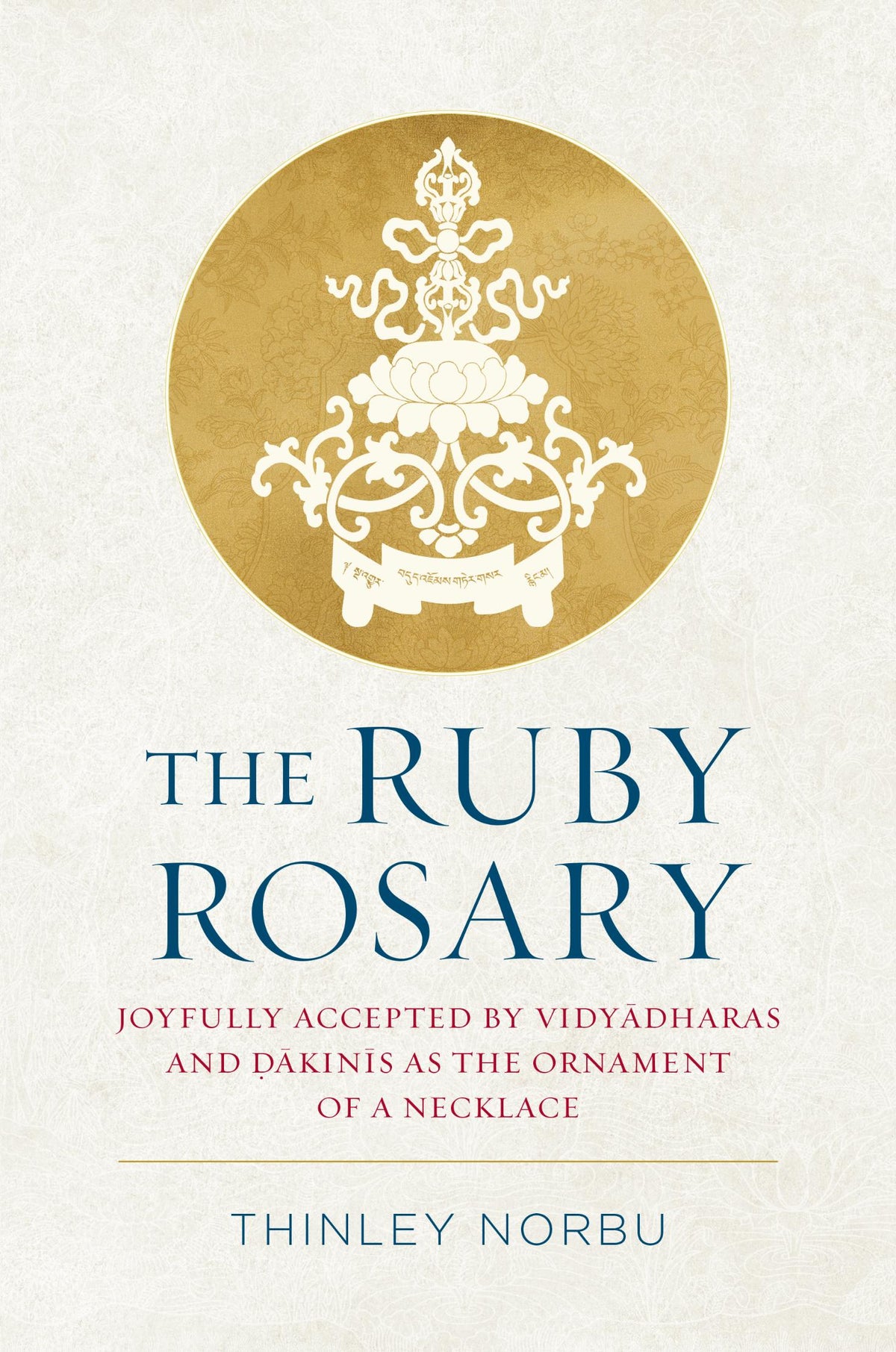
Thinley Norbu Rinpoche, the eldest son of Dudjom Rinpoche and considered an emanation of Longchenpa, wrote a commentary to this prayer now published as The Ruby Rosary: Joyfully Accepted by Vidyadharas and Dakinis as the Ornament of a Necklace.
The first half of this work is a clear account of how the teachings of the Buddha, including the the Shravakayana, Mahayana, and Vajrayana teachings, all came to be.
The second half details the nineteen primary incarnations of the Dudjom line.

1. Nuden Dorje Chang
Nuden Dorje Chang, "Powerful Vajradhara," is the first in the series of Kyabje Dudjom Rinpoche's lifetimes. He was a supreme powerful yogin and "the crown of all thousand Buddhas" of this fortunate eon. Through profound aspirations, he conferred empowerments, made prophecies and granted blessings to each of the 1,002 Buddhas of the eon. Countless ages ago he vowed to appear as Buddha Adhimukta (Möpa Taye), the last Buddha of the eon, which links the beginning of Rinpoche's lineage to its future end.
2. Śāriputra
Śāriputra appeared as a follower of Buddha Śākyamuni, but the text says he was an emanation who appeared as an Arhat, supreme among those with sublime knowledge, with realization no different from the Buddha's. He was born to the Brahmin Tiṣya and Śārikā, which is why he was named Śāriputra, "Son of Śārikā". He grew up learned in the four Vedas and able to defeat anyone in debate. Together with Maudgalyāyana, who was supreme in miraculous abilities, he is known as one of the "two supreme disciples", and he was the second in Dudjom Rinpoche's series of lifetimes.

3. Saraha
Brahmin Saraha was the third lifetime and is counted among the Eighty-Four Mahāsiddhas of India, having gained supreme accomplishment. In the Bodhgayā oral tradition he was born in Suvarṇimadroṇa as the elder of two Brahmin brothers. After a journey to Mount Kailash, the brothers rejected the Vedic teachings, and Rāhula ordained the elder as Rāhulabhadra and taught him Guhyasamāja. He ordained Nāgārjuna, his main disciple, and entrusted Nālandā to him. He then lived with an arrowmaker's daughter, and when people criticized him he answered with his three Dohā songs. The prayer praises him as the one who shot the "wisdom arrow" at sentient beings' belief in ego and introduced them to Mahāmudrā.
Also see our volume on Saraha from our Lives of the Masters series.

4. Kṛṣṇadhara or Krishnadzin
Kṛṣṇadhara, the fourth lifetime, was the Buddhist minister of King Indrabhūti of Oḍḍiyāna. The king had 108 queens but no son, and he had nearly emptied his treasury on beggars. Kṛṣṇadhara was learned and honest, and he stood out among the ministers for carrying out the king's laws and commands exactly. On a voyage to retrieve a wish-fulfilling jewel, he saw the boy Padmasambhava born from a lotus and invited him to become the king's son. This fulfilled the king's hopes, and the jewel relieved his subjects' poverty.

5. Hūṃkāra
Ācārya Hūṃkāra, the fifth lifetime, was renowned throughout India and Nepal. He was born in Nepal to a Brahmin family and became very learned in the Vedas and in non-Buddhist philosophies. His faith in the Buddha's teaching then drew him to Nālandā in Central India, where he was ordained. He held the Kama transmission of Viśuddha Mind (Yangdak Heruka), and the prayer praises him as an awareness holder who mastered the stainless wisdom of the Dharmadhātu.

6. Drogben Khyeuchung Lotsawa
Drogben, the sixth lifetime, was the "Boy Translator" of the Drogmi clan and one of Guru Rinpoche's King and Twenty-Five Subjects, in the 8th century. He could translate from his youth, and he received the empowerments and oral instructions of the Oceanlike Collection of Teachings from Padmasambhava. By practicing one-pointedly, his wisdom became equal to the Guru's, and his mere gaze could draw birds from the sky. He kept lay householder ordination, wearing the white robes and long hair of a mantra holder.

7. Smṛtijñāna
Ācārya Smṛtijñāna (892–975), the seventh lifetime, was an Indian paṇḍita whom Mañjuśrī actually blessed and guided, and he attended many teachers, including Nāropa. Being clairvoyant, he went to Tibet for the sake of his mother, who had been reborn as a scorpion inside a villager's stove, and he lived there disguised as a cowherd. He wrote a Sanskrit verse above the gate at Gungtang, and the translator Chal Lotsawa recognized his handwriting and sought him out. They bought the stove, and Smṛtijñāna guided his mother to the higher realms with a ritual for cleansing the lower realms before leaving for Kham.

8. Rongzom Chökyi Zangpo
Rongzom, the eighth lifetime, is described as the foremost of the learned and accomplished masters of India and Tibet. He had mastered the ten sciences, which are the five major sciences of art, medicine, language, logic and philosophy, and inner awareness, together with poetry, semantics, composition, performing arts, and astrology. The Blue Annals, as quoted in the book, calls him and Milarepa the "two earrings" of Tibet, with Padmasambhava as its single crown jewel. The book's bibliography also credits him with translating the Archenemy Yamāntaka Tantra into Tibetan.
See our Reader's Guide to Rongzompa

9. Katok Dampa Deshek
Katok Dampa Deshek (1122–1192), the ninth lifetime, was born Sherab Senge in the Four Rivers and Six Ranges region, and his elder brother was Phagmo Drupa. He studied under more than a hundred masters across Kham and Central Tibet and mastered all the Buddhist vehicles. In 1159, at the age of thirty-eight, he founded Katok Monastery, which grew to nearly 80,000 monks. He wrote works that filled more than nineteen volumes and named Tsangtön Dorje Gyaltsen his regent, and at the end he passed into peace facing west.

10. Lingje Repa
Lingje Repa (1128–1188), the tenth lifetime, was the heart-son of Deshek Phagmo Drupa and was born in Upper Nyang in Tsang. He practiced as a yogin together with the noblewoman Menmo, and at thirty-eight he went to Phagmo Drupa. After only three days of a vowed seven-year retreat, unimpeded realization arose in him. He swallowed a scripture at Samye and afterward knew every teaching, he founded a monastery at Napu, and his last teaching told his followers to look within their own minds to meet him.

11. Drogön Chögyal Phagpa
Chögyal Phagpa (1235–1280), the eleventh lifetime, was the son of Zangtsa Sönam Gyaltsen and was held to be Mañjuśrī in the form of a human king. He was a Bodhisattva on the higher bhūmis who intentionally took rebirth, and his miracles included slicing off his head and limbs and turning them into the five Buddha families. These miracles caused unswerving faith in the Mongolian king Kublai Khan, who received empowerment from him three times. In return the king offered him authority over the thirteen myriarchies of Central Tibet, the three provinces of Tibet, and Khotan.
See also our Reader's Guide to Chogyal Phakpa

12. Kharnakpa of Drum
Kharnakpa of Drum, the twelfth lifetime, was a mighty treasure revealer with mastery over miraculous powers. The prayer says he saw Dharmatā just as it is, free of elaboration, and attained the unwavering Dharmakāya. A passage revealed jointly by this tertön and his patron-disciple Nagpo Khar of Paro criticizes the Tibetan religious scene of his time. It also foretells the revealing of a treasure hidden in Paro, Bhutan, which was extracted from an amulet in the beak of a brown garuḍa at the Khyerchu Temple.

13. Hepa Chöjung
Hepa Chöjung, the thirteenth lifetime, was born at Drakar in the Sangen region. He received the empowerments and reading transmissions of Pema Lingpa's Peaceful and Wrathful Deities from Kongpo Gyarawa Namkha Chökyi Gyatso and composed many ritual arrangements. He was the principal successor of the Dharma lineage holder of Katok Dampa Deshek. The prayer compares him to Indra wielding the vajra, since he annihilated vicious beings who harmed others or scorned the teachings and could not be subdued by peaceful means.

14. Tragtung Dudul Dorje
Tragtung Dudul Dorje (1615–1672), the fourteenth lifetime, was clearly prophesied in thirteen ancient treasure texts. He was born near Derge in Dokham, had many pure visions from the age of six, and at twenty-nine brought out his first main treasures from Puwo Dongchu. He revealed hidden lands, among them Pemakö, along with teachings, wealth treasures, and samaya substances that liberate through tasting. He built the Dudul Lhakang, and at fifty-eight he passed into the Palace of Lotus Light, leaving a one-cubit-high body.

15. Gyalse Sönam Detsen
Gyalse Sönam Detsen (1679–1728), the fifteenth lifetime, was the immediate reincarnation of Dudul Dorje, and the text calls him the descendant and lineage holder of Longsal Nyingpo's teachings. He was born in the Wood Hare year and studied with many masters, among them his father Longsal Nyingpo, the eighth Shamar Rinpoche, and Dzogchen Pema Rigdzin. He stayed at Katok Monastery and looked after its Saṅgha for many years. The prayer says he illuminated the Kama and Terma tradition of the absolute meaning, and his wisdom mind dissolved into the Dharmadhātu at forty-nine.

16. Dudul Rolpa Tsal
Dudul Rolpa Tsal, of the 18th century and the sixteenth lifetime, was the immediate rebirth of Gyalse Sönam Detsen. He was born at Ajam in the Sangen Rekhe district, and his father, Katok Dudul Gyalse Pema Namgyal, was clairvoyant. He mastered his life span, living nearly 180 years, and he discovered many profound treasures, among them Red Garuḍa with Wings of Fire. His wrathful activity brought vicious humans and nonhumans under his power, and he was enthroned as head of the monasteries from Katok Dorje Den to Sangen.

17. Garwang Dudjom Pawo (Dudjom Lingpa)
Dudjom Lingpa (1835–1904), the seventeenth lifetime, was born in Lower Dokham in the Female Wood Sheep year to a father named Ahten and a mother named Mutsa Bodzok. The book says he did not rely on arduous training, because he received the uninterrupted blessings of Samantabhadra's Wisdom Mind Lineage through self-appearing nonhuman teachers. In 1859, at twenty-five, he retrieved his first treasure at Bate in Mar, and in time he revealed the Profound Secret Heart Essence of the Ḍākinī. In vision he spent twelve years on the Copper-Colored Mountain, where Guru Rinpoche appointed him his regent, and he used wrathful protector practices against those who attacked him.


Jigdral Yeshe Dorje (Kyabje Dudjom Rinpoche)
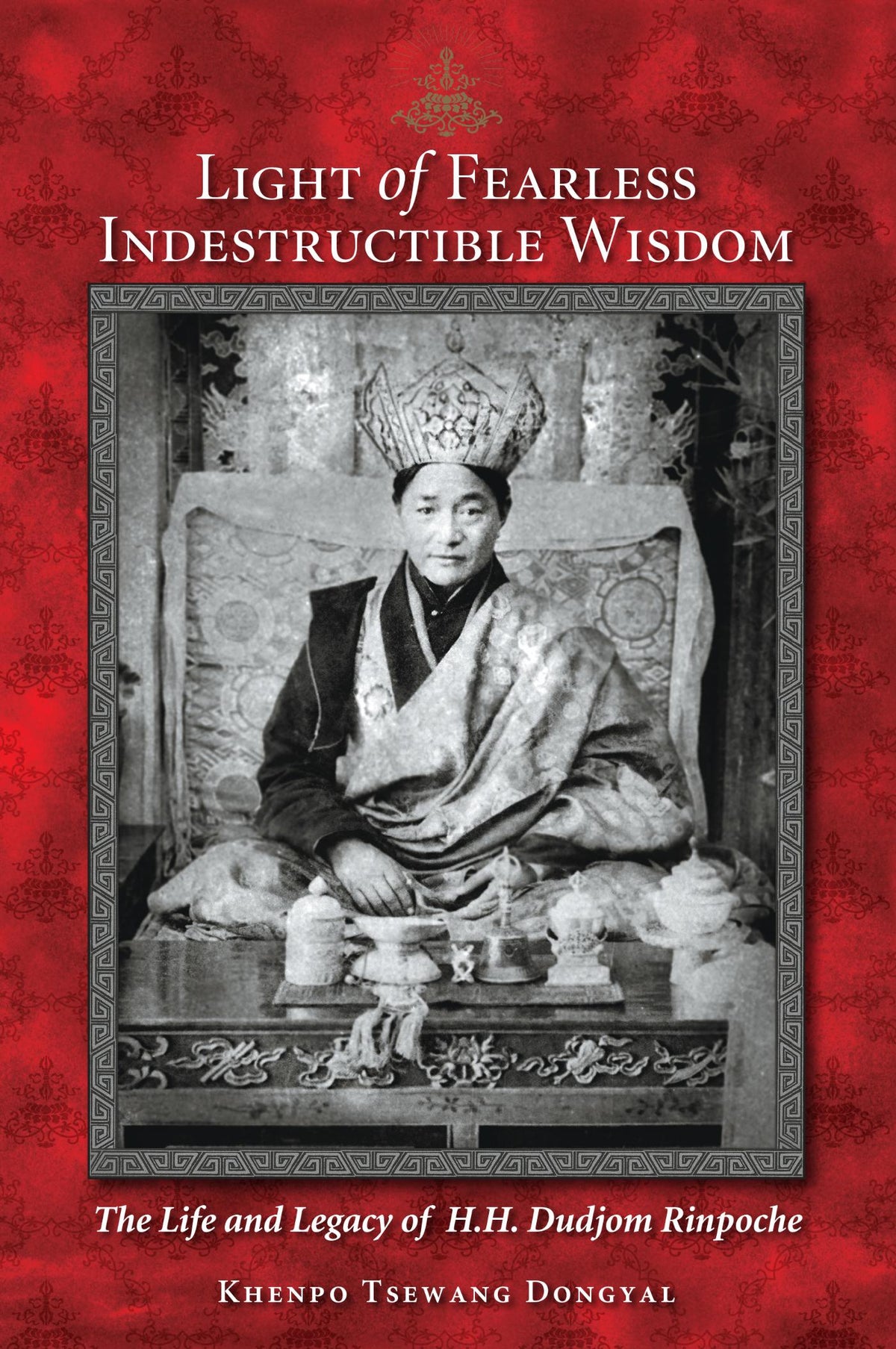
Dudjom Jigdral Yeshe Dorje was born in the hidden land of Pemakö in the Wood Dragon year (1904) with the marks of a Nirmāṇakāya. From his youth Guru Rinpoche and his consort appeared to him, enthroned him as Guru Rinpoche's regent, and gave him the name Orgyen Garwang Drodul Lingpa Tsal. He is described as the body emanation of Drogben, the speech emanation of Yeshe Tsogyal, and the mind emanation of Padmasambhava, and he became renowned as an unrivaled king of scholars. To prevent the decline of the Early Translation school he founded Buddhist communities on a vast scale, among them Bejong Ewam Dechen Chökhor Monastery.
See our Reader's Guide to Dudjom Rinpoche
Yangsi Dudjom Sangye Pema Zhepa Rinpoche
Yangsi Dudjom Sangye Pema Zhepa Rinpoche (1990-2022), Dudjom Rinpoche's direct rebirth, wrote the foreword to this book.
See our post about Yangsi Dudjom Rinpoche.

Dorje Nönpo
Dorje Nönpo, in Sanskrit Vajratīkṣṇa ("Sharp Vajra"), is an epithet of Mañjuśrī, and the prayer says Dudjom Rinpoche will appear in Shambhala under this name. He will take rebirth as Raudra Cakrin, "Fierce Iron Wheel Holder", the twenty-fifth Kalkī king in the line that began with Dharmarāja Sucandra. Shambhala is where Buddha Śākyamuni turned the wheel of the Kālacakra Tantra for Sucandra. When barbarians try to harm the Buddha's teachings, the Kalkī king will defeat their armies with wrathful compassion, enthrone Brahmā and Indra, and spread the Holy Dharma.

Möpa Taye (Buddha Adhimukta)
Möpa Taye is Buddha Adhimukta, the final guide of this fortunate eon and the last of its thousand Buddhas, who is to be a future emanation of Dudjom Rinpoche. As the youngest prince, Lodrö Taye, among King Dhṛtarāṣṭra's thousand sons, he vowed to have the combined life spans and deeds of all the other Buddhas, and the voice of the gods answered, "May it be so!" The text says all the qualities of the other Buddhas' life spans, deeds, and retinues will merge into him. With the four limitless ways of subduing beings, he will dredge the depths of the realms of beings and establish them in enlightenment.