

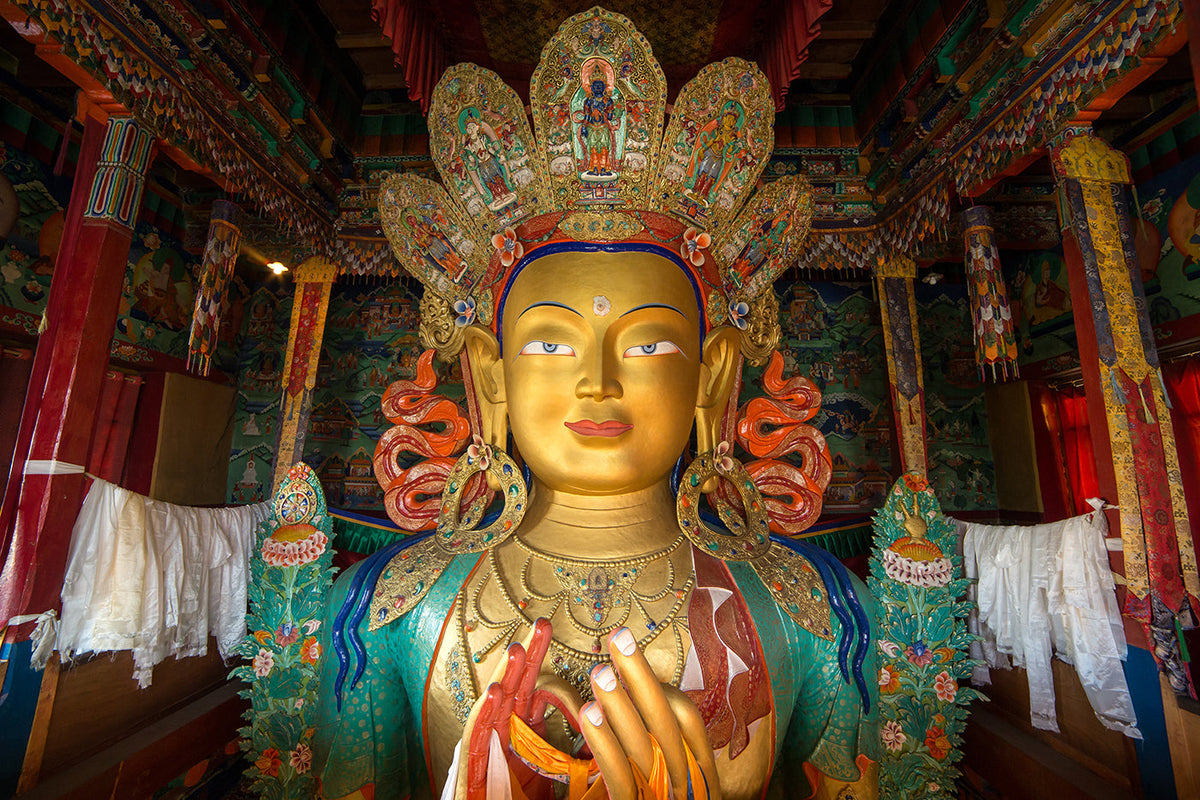
What is the Madhyantavibhaga? Maitreya’s text on distinguishing the middle beyond extremes, explaining Yogacara’s three natures and the path to nondual wisdom.
About the Work
In English, this text is commonly translated as "The Middle Beyond Extremes" or "Distinguishing the Middle from the Extremes".
In Sanskrit, the title is the Madhyāntavibhāgakārikā.
In Tibetan, it is དབུས་དང་མཐའ་རྣམ་པར་འབྱེད་པའི་ཚིག་ལེའུར་བྱས་པ།
In Wylie, it is dbus dang mtha' rnam par 'byed pa'i tshig le'ur byas pa.
This text is known in the Chinese tradition as Bian zhong bian lun song ( 辯中邊論頌)
See More from the Series on the Five Maitreya Texts
Overview of the Five Maitreya Texts
1. The Ornament of Clear Realization, the Abhisamayālaṃkāra
2. The Ornament of the Mahayana Sutras, the Mahāyānasūtrālaṃkāra
4. The Distinction Between Phenomena and Their Nature, the Dharmadharmatāvibhāga
5. The Ultimate Continuum of the Mahāyāna Ratnagotravibhāga (Uttaratantra)
See also:
A Reader's Guide to Asanga and Yogacara
The Five Maitreya Texts as Zip Files with Karl Brunnholzl
On Translating the Five Treatises of Maitreya with Thomas Doctor
The Madhyāntavibhāga (“Distinguishing the Middle from Extremes”) is a central Yogācāra treatise that explains how to avoid the two extremes of existence and non‑existence by analyzing how experience actually appears to the mind. It presents the core Yogācāra framework of the three natures:
- the imagined (false dualistic appearance of subject and object)
- the dependent (the flow of causes and conditions, especially mind and its impressions)
- and the perfected (the ultimate, nondual nature of phenomena, free from all projections)
The text shows how our habitual clinging to the imagined nature gives rise to suffering, and how insight into the dependent nature undermines that clinging. Fully realizing the perfected nature is described as the “middle beyond extremes,” a direct, nonconceptual knowing that is neither nihilistic (denying appearances) nor eternalistic (asserting any inherent essence).
Across its chapters, the Madhyāntavibhāga outlines:
- the characteristics of confusion and its cessation
- the distinction between what is truly existent (the perfected nature) and what is only imputed
- the stages of the path that purify afflictive and cognitive obscurations
- and the resulting qualities of enlightenment, in which compassion and wisdom are inseparable.
In short, it is both a philosophical map of how dualistic appearances arise and a practical guide for transforming that deluded perception into the direct realization of nondual reality.
Middle Beyond Extremes: Maitreya's Madhyantavibhaga with Commentaries by Khenpo Shenga and Ju Mipham
A translation and commentary on Madhyāntavibhāga, presenting the root text with a detailed explanation of the three natures, obscurations, remedies, and path. It includes the commentary of Mipham Rinpoche as well as the annotations of Khenpo Shenga.

Adorning Maitreya’s Intent: Arriving at the View of Nonduality
Translated and introduced by Christian Bernert
Rontongpa's Yogācāra commentary is structured largely around the three‑nature model as taught in Madhyāntavibhāga, including a meditation manual explicitly based on it. The work is broader Yogācāra, but the Madhyāntavibhāga is a central textual basis.
Tibetan master Rongtön unpacks this manual and its practices for us in a way that is at once accessible and profound, with actual practical meditative applications. The work explains the vast paths of the three vehicles of Buddhism, emphasizing the view of Yogācāra, and demonstrates the inseparability of experience and emptiness. It offers a detailed presentation of the three natures of reality, an accurate understanding of which provides the antidotes to confusion and suffering. The translator’s introduction presents a clear overview of all the concepts explored in the text, making it easy for the reader to bridge its ideas to actual practice.
Here is Christian Bernert discussing the work:

A Compendium of the Mahayana: Asanga’s Mahayanasamgraha and Its Indian and Tibetan Commentaries
While focused on Mahāyānasaṃgraha and ālaya‑consciousness, it explicitly treats the three natures as formulated in Yogācāra (drawing also on texts like Triṃśikā). It’s a major contextual source for understanding the same three‑nature system that Madhyāntavibhāga, which is brought up over 150 times in the text, uses.
Volume 1 presents the translation of the Mahāyānasaṃgraha along with a commentary by Vasubandhu. The introduction gives an overview of the text and its Indian and Tibetan commentaries, and explains in detail two crucial elements of the Yogācāra view: the ālaya-consciousness and the afflicted mind (klistamanas).
Volume 2 presents translations of the commentary by Asvabhāva and an anonymous Indian commentary on the first chapter of the text. These translations are supplemented in the endnotes by excerpts from Tibetan commentaries and related passages in other Indian and Chinese Yogācāra works.
Volume 3 includes appendices with excerpts from other Indian and Chinese Yogācāra texts and supplementary materials on major Yogācāra topics in the Mahāyānasaṃgraha.

Center of the Sunlit Sky: Madhyamaka in the Kagyu Tradition
by Karl Brunnhölzl
This work explicitly discusses The Distinction between the Middle and Extremes and Vasubandhu’s commentary, including the twenty-eight extremes and the relationship between Yogācāra and Madhyamaka understandings of the middle. Particularly relevant material appears around page 519.

Groundless Paths: The Prajnaparamita Sutras, The Ornament of Clear Realization, and Its Commentaries in the Tibetan Nyingma Tradition
While focused on the Ornament of Clear Realization (Abhisamayalamkara), it discusses the Madhyāntavibhāga, which is brought up over 33 times in the text when mapping afflictive/cognitive obscurations, buddha‑nature, and the structure of the Mahāyāna path.

Additional Resources
See More from the Series on the Five Maitreya Texts
Overview of the Five Maitreya Texts
1. The Ornament of Clear Realization, the Abhisamayālaṃkāra
2. The Ornament of the Mahayana Sutras, the Mahāyānasūtrālaṃkāra
4. The Distinction Between Phenomena and Their Nature, the Dharmadharmatāvibhāga
5. The Ultimate Continuum of the Mahāyāna Ratnagotravibhāga (Uttaratantra)
See also:
A Reader's Guide to Asanga and Yogacara
The Five Maitreya Texts as Zip Files with Karl Brunnholzl
On Translating the Five Treatises of Maitreya with Thomas Doctor

The Rigpa Wiki entry on the Madhyāntavibhāga


