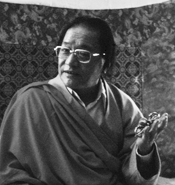
Wisdom Nectar
Translated by Ron Garry
By Dudjom Rinpoche
Foreword by Lama Tharchin
Errata for Wisdom Nectar
A portion of text from the General Introduction was omitted in error on page 21 in the printed book. Please see below for the full corrected text of the second paragraph.
—
My intention in writing this introduction to Dudjom Rinpoché’s teachings is to provide a context for the reader to realize what a gift we literally hold “in the palm of our hands,” in the form of this book that contains a collection of His Holiness’s pith instructions. I find for myself that reading with an open heart—reading with faith and devotion—is the key that allows the master’s essential teachings to penetrate deep within. If you are already familiar with Dudjom Rinpoché, you undoubtedly have an appreciation for the writings translated in this book and there may be no need for you to read this introduction. If you are not familiar with Dudjom Rinpoché, I hope the introduction to his heart advice will inspire you to savor his writings slowly and carefully, with the knowledge that each and every line of these teachings has the ability to bring us to full liberation.
In the simplest words, Dudjom Rinpoche’s teachings help us to live from the inside out. Through practicing the Buddha’s teachings with faith and devotion, it is possible to become free of all circumstances, both positive ones that lead to feelings we enjoy and negative ones that lead to feelings we dislike.
Generally, we are attracted to circumstances that give rise to feelings that we want, and we try our best to avoid circumstances that trigger feelings we don’t want. For instance, right now I hear the songbirds of springtime outside my window, while morning sunlight shines through shimmering green bamboo leaves blown by a warm, fragrant breeze. It is Saturday morning, and I decide to stay home and enjoy this gorgeous time. These circumstances create a feeling that is hard to describe; perhaps words that come close are peacefulness, serenity, and happiness. I have a strong sense of enjoyment, and I try to recreate it, consciously and unconsciously. This attempt underlies my choices of the house I live in, the type of garden I cultivate, and the car that I drive.