For five decades, we’ve been publishing books for enlightened living . . .
Shambhala Publications was born at Ground Zero of the 1960s counterculture: in the back of a bookstore on Telegraph Avenue in Berkeley, California. It’s ironic, since our founders’ vision was more trans-cultural than countercultural--the concern being for an enlightened approach to every aspect of life—including culture. It’s a vision that hasn’t changed in five decades, as we’ve crossed the continent, and as we’ve grown to discover just how much that original vision can contain.
Top row from left: Steven Goodman (Bookseller), Joanne Fagan holding Jeremy Fagan, Bob Harrison (Bookseller), Bob Pasternak (Bookseller), Michael Fagan (Partner in Shambhala Publications & Bookstore), Beverly Cancilla (Bookkeeper), Hal Hershey (Book Designer) Bottom row from left: Teresa Parks, Hazel Bercholz (Owner & Cover Designer), Sam Bercholz (Owner & Founder)
Sam Bercholz (Owner & Founder) & Michael Fagan (Partner in Shambhala Publications & Bookstore)
1969: Auspicious Beginnings
"Shambhala Publications began as a sort of after-school activity," recalls our Chairman and Editor-in-Chief Samuel Bercholz. "Originally we just wanted to have a place where people could exchange ideas, a sort of meeting place. But a meeting place had to have some way of keeping itself going, so we became a bookstore. From the bookstore, we felt that there was information that should be passed on to a larger community than just the college community around Berkeley. So we published a thousand copies of our first book, sold around the San Francisco Bay Area." That first book—Meditation in Action by Chögyam Trungpa, a Tibetan Buddhist teacher then living in Scotland—set the tone for all that was to follow, and it remains in print to this day.
At a time of growing interest in mystical paths of inner development, here was a book that spoke in an unusually direct and accessible way about spirituality as a sane and practical approach to life: not an obscure doctrine unconnected with experience, but a clear vision of reality that could be expressed beyond the meditation cushion, in everyday activities and all spheres of human endeavor.
Hailed by reviewers as "the bible for bread baking," Edward Espe Brown’sTassajara Bread Book was welcomed by a generation fed up with "supermarket squish." The author, then head cook of a Zen meditation retreat in California, offered a philosophy as wholesome as his natural ingredients, encouraging readers to bake with love, awareness, and a sense of the sacred dimension of everyday life. His follow-up volume, Tassajara Cooking (1973), was a basic vegetarian cookbook that’s fun to read, simple to use—and not too ascetic: as Brown wrote, "No sugar, no enlightenment."
1973: Seeing Through the Ego’s Tricks
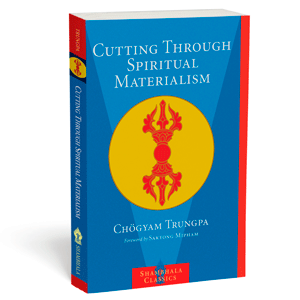
In the supermarket of spiritual techniques, there was also a squish factor to contend with. ChögyamTrungpa’s second book, Cutting Through Spiritual Materialism, offered much-needed guidance in discriminating between authentic spiritual practice and what he called "spiritual materialism," the tendency of ego to distort the spiritual path to its own ends. We eventually published twenty-one books by Chögyam Trunpga, including his eight-volume Collected Works, and numerous posthumous works, like Work, Sex, Money and more recently, the celebrated Sadhana of Mahamudra.
Hazel Bercholz (Owner & Cover Designer)
1974: Looks Like the Beginning of a Beautiful Relationship
Thanks to our early successes, New York publishing houses began deluging Sam with offers to distribute Shambhala books to the trade. The idea of teaming up with a big corporation wasn’t seriously considered until James Silberman of Random House, Inc., came along and the chemistry was right. A personal, congenial relationship with Random House and its dynamic sales force has continued fruitfully to this day, enabling Shambhala to gain international visibility while preserving editorial independence. At thirty-eight years and counting, it’s likely one of the longest such distribution relationships in publishing.
1975: Quantum Theory Meets Nirvana
Is the cosmic dance of the god Shiva just another way of saying E=mc2? Did the new physics merely rediscover what the ancient mystics of the East learned centuries ago through meditation? Probably not, as even Fritjof Capra concedes, yet his 1975 book The Tao of Physics, exploring the parallels between Eastern spirituality and Western science, was destined to become a classic. Now in its fourth edition and still going strong, it continues to have wide popular appeal because of its visionary recognition of the interplay between mysticism, intuition, and scientific analysis.
Chögyam Trungpa (1940–1987)—meditation master, teacher, and artist—founded Naropa University in Boulder, Colorado
1975: In-Between…and Loving It
The Tibetan Book of the Dead was the first book to bring Tibetan Buddhism to the attention of the West when it appeared in 1927 in an English translation by W.Y. Evans-Wentz. The text contains meditation instructions to be practiced in the bardo, or in-between state, between death and rebirth. It is traditionally read aloud at the time of death and for up to forty-nine days afterward, at which time the person is said to be reborn. Fascination with the doctrine of reincarnation made the book famous, but alas, it was not very readable. Reviewers and readers welcomed our lucid new translation by Francesca Fremantle and Chögyam Trungpa, designed as a book for the living, with a commentary by Trungpa elucidating the text’s insights into human psychology.
1976: We Cross Half a Continent
By 1976, it was time for a change, and Sam Bercholz decided to move the company to Boulder, Colorado. "There’s an illusion in Berkeley that you’re in the forefront of thought," he remarked at the time. "And it’s just an illusion." In Boulder, Shambhala was closer to many of its authors, including Chögyam Trungpa, and to the Naropa Institute (now known as Naropa University), America’s first Buddhist university, which was a helpful source of contacts. Besides, Sam said, "We like it here."
Dr. Thomas Cleary (1949–2021), one of the most celebrated translators of spiritual classics into English
1977: The Cleary Phenomenon Begins
The mammoth Blue Cliff Record—over 600 pages of Zen koans and commentary from twelfth-century China—marked the debut of an outstanding scholar and translator of Asian sacred literature, Thomas Cleary (who collaborated on the book with his brother J. C. Cleary). Tom would go on to produce an astonishing array of classics over the next decades—more than thirty key works of Eastern wisdom, including The Flower Ornament Scripture, several versions of the I Ching, Taoist alchemical manuals, and teachings of great Chinese and Japanese Zen masters. His books were devoured not only by serious practitioners, but also, in some cases, by business people eager to learn the ancient Oriental arts of leadership and strategy.
Ken Wilber, one of the most widely read and influential American philosophers of our time
1981: Transpersonal Best
What can we say about a man who has been likened to Thomas Aquinas, William James, and Albert Einstein—except to add that we’re glad he’s Ken Wilber and that he’s published a few books with us. A leading theorist in consciousness research and transpersonal psychology, Wilber is best known for his "full-spectrum model" of human consciousness, from the most basic stages of development to the highest spiritual attainments. No Boundary: Eastern and Western Approaches to Personal Growth (1981) presents this framework in a simplified form, relating the spectrum of consciousness to the major schools of psychology as well as to the mystical traditions of the East. His recent opus, Sex, Ecology, Spirituality—the first volume of his Kosmos trilogy (and its short, popular version, A Brief History of Everything)—has aroused both ardent praise and excited controversy. We admire Ken, not only for his Einsteinian qualities, but for his groundedness in spiritual practice, the example he sets of intellect in the service of truth, and perhaps most of all, his sense of humor.
Interviewer: Ken, how much of the spectrum of consciousness is familiar territory to you? Ken: I’m at chakra one and a half, and I'm trying to work my way up to the Oedipal complex.
We were very pleased to bring out Ken’s Collected Works in a six-volume set in 1999.
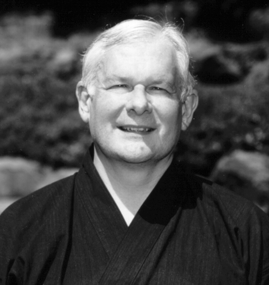
John Stevens, author or translator of over forty books on Zen artists and their poetry, painting, and calligraphy, as well as on Aikido, swordsmanship, and other Japanese martial arts traditions
1984: How to Be a Warrior
Our first martial arts book, John Steven’sAikido: The Way of Harmony, was an auspicious start to what has been a satisfying part of our list, which now includes Aikido books by Mitsugi Saotome, T’ai Chi books by Waysun Liao and Paul Crompton, and a Qigong book by John Alton.
Another important title this year was Chögyam Trungpa’s Shambhala: The Sacred Path of the Warrior, showing how to bring the principles of sacredness, dignity, and warriorship into the conduct of our ordinary lives.
Inside Shambhala's Office in Horticultural Hall, Boston, MA
1985: We Complete Our Crossing of the Continent
It was time for a new illusion. Shambhala’s eastward expansion continued when eight households packed up and moved to Boston, setting up shop in the Back Bay in an elegant old building that had once housed a convent. We ended up leaving the convent a couple years later to take up residence in Boston's venerable Horticultural Hall, where we remained for a quarter of a century. The move placed the company in closer proximity to the mainstream of book publishing, allowing greater contact with authors, media, and the marketplace.
Natalie Goldberg, author of fifteen books. Writing Down the Bones, her first, has been translated into nineteen languages.
1986: Keep the Pencil Moving…
We’re not sure, but Natalie Goldberg’sWriting Down the Bones may have generated more fan mail than any book we’ve ever published. A word-of-mouth sensation, it began life modestly, with a small print run, and then soared off into best-seller-dom. In a series of short chapters full of humor, wisdom, and good advice, Goldberg—a writer, poet, and Zen meditator—instills aspiring writers with inspiration and self-confidence. The success of Bones opened the way for us to publish other books on creativity.
1987: "To win without fighting is best…"
Thomas Cleary’s translation of Sun Tzu’s classic of military strategy, The Art of War, became one of our best-sellers of the eighties. Its simple and skillful methods for avoiding conflict—and for waging war honorably when necessary—resonated with businesspeople who saw in it methods for people management that worked as well in modern offices as they had in the battlefields of Han dynasty China.
Marie-Louise von Franz (1915–1998) was the foremost student of C. G. Jung, with whom she worked closely from 1934 until his death in 1961. A founder of the C. G. Jung Institute of Zurich, she published widely on subjects including alchemy, dreams, fairy tales, personality types, and psychotherapy.
1989: Jung and Restless
This was the year we began our relationship with the C. G. Jung Foundation for Analytical Psychology in New York City to produce the C. G. Jung Foundation series. Interest in Jung was intense at the time, and for nearly a decade we published extensively in that realm, both in this series and outside it—including authors such as Marie-Louise von Franz, Edward F. Edinger, Ann Belford Ulanov, Marion Woodman, Robert Bosnak, and Linda Leonard. Though we’re no longer able to publish as many books on Jungian psychology as we once did, these books remain stalwarts of our backlist, and we cherish fond memories of our Jungian years.
1990: Pocketable Editions
With visions of wee booklings dancing in our heads, we gleefully introduced Shambhala Pocket Classics in Autumn 1990: 3 x 4-1/2-inch paperback books that fit nicely in a Christmas stocking, a shirt pocket, or the palm of your hand. These delightful small books proliferated (and were much imitated) throughout the 1990s, and have now become collector's items. The series of nearly 80 little books came to include a range of spiritual and literary classics that astonished even us, and that included such works as the Tao Te Ching; Rilke’s Duino Elegies; Zen Flesh, Zen Bones; The Way of a Pilgrim; Merton’s Thoughts in Solitude; Thoreau’s Walden—and a compact edition of our very first book, the ubiquitous Meditation in Action.
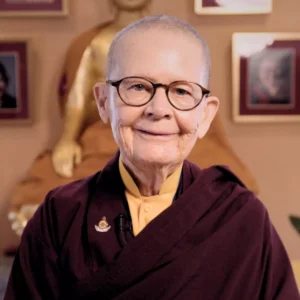
Pema Chödrön, beloved nun, teacher, and author is well known for her countless books on Buddhist thought and practice. Ani Pema served as the director of Karma Dzong in Boulder, Colorado, until moving in 1984 to rural Cape Breton, Nova Scotia, to be the director of Gampo Abbey.
1997: Everybody’s Favorite Nun
We actually began publishing the American Buddhist nun Pema Chödrön in 1991, with her first book, The Wisdom of No Escape, followed in 1994 with Start Where You Are. But it was her When Things Fall Apart, in 1997, that broke out to become one of the most popular books we’ve ever published. Her radical advice for approaching life's difficulties just seems to ring deeply true with people from many backgrounds. Publishers Weekly called it "the Tibetan Buddhist equivalent of Harold Kushner's When Bad Things Happen to Good People." We’ve gone on to publish numerous other books by her. Observing the positive effect they have in people’s lives has been a most gratifying experience.
Joseph Goldstein, author of many books, including Mindfulness: A Practical Guide to Awakening and One Dharma: The Emerging Western Buddhism
Special edition of Pema Chödön's When Things Fall Apart
2002: The Book as Beautiful Object
An important part of our mission from the beginning (in addition to publishing original works) has been to make the great spiritual classics available and accessible. One of the more satisfying results of this objective has been the birth of the Shambhala Library series. Books in this series are smallish (4 1/4" x 6 3/4") hardcovers with full cloth binding, ribbon markers, and exquisite production values throughout. They’re a joy to hold. And the series has given us the great privilege of publishing fine editions of a range of great works, from Hermann Hesse to Shunryu Suzuki to Henry David Thoreau.
2004: Weatherhill Joins the Fold
Our thirty-fifth anniversary coincided with our purchase of Weatherhill, Inc., for many years a respected publisher of books on Asia and the Pacific. This event instantly increased the size of our backlist with many exquisitely produced books on the arts, culture, and religion of Japan and other parts of Asia. In addition, it gave us the honor of being the publisher of Suzuki Roshi’s classic, Zen Mind, Beginner's Mind.
2005: The Trumpet Sounds
Midway through our third decade our program has expanded to include an entirely new publishing identity. With Trumpeter Books we have moved further into the publishing mainstream, with books encompassing a broad range of topics all aimed at nourishing our positive potential as human beings. First titles include Susan Senator’s Making Peace with Autism and the poet Patrick Lane’s stunning memoir of coming to life after alcoholism, What the Stones Remember.
Our acquisition of Snow Lion Publications was in some ways more like a marriage than a business deal, since they’d been our esteemed colleagues in Buddhist publishing for well over twenty years—and the marriage has been a happy one. With the addition of their several hundred core Tibetan Buddhist titles to our list, our position as the premier publisher of books on Buddhism in English has been firmly established (in case there was any doubt), even as our list has continued to expand into new and sometimes surprising subject areas.
Shambhala Publications returns once again to Boulder to be part of the vibrant community of Buddhists, yogis, and health-conscious people who live there. The staff expands to over 40 full-time employees.
During the COVID-19 pandemic of 2020-2021, the shift to remote work enabled the company to hire remote employees and recognize that they could operate with less physical office space. As a result, Shambhala decided to move to a smaller location that could accommodate their library of publications, a meeting space, and fewer offices. They selected a 1900 Victorian house in Boulder and once again enlisted Tres Birds to help reimagine their offices within the new space.
2024-2025 The Archive Library finds a home
After the move to Pearl st. Shambhala's archive library was temporarily boxed up in the office basement. In 2025 Ivan Bercholz revealed the library's beautiful new location which doubles as a shrine room and place for meditation practice events.
Looking to the Future…
Over the five decades of our adventure in independent publishing, we’ve watched the culture change around us: what was considered countercultural back in 1969—things like Buddhism, martial arts, yoga, or alternative medicine—has now become mainstream, even commercial. We’ve also experienced change within: our history demonstrates just how many new subjects we’ve explored that none of us would even have thought of back when we started out. But each of our books, whatever its subject, is an expression of our belief that there’s an enlightened way of approaching every aspect of our lives. That original vision has never changed, and though you can continue to expect surprises from us, you can also expect that original vision to continue to guide everything we do.