Anagarika Munindra: A Guide for Readers

Munindra

Anagarika Munindra (1915–2003) was a Bengali Buddhist master and scholar who became one of the most important Vipassana meditation teachers of the twentieth century. Unassuming, genuine, and always encouraging, Munindra embodied the Buddhist teachings, exemplifying mindfulness in everything he did. The following is an excerpt from the brief biography included in Mirka Knaster's Living This Life Fully by Robert Pryor, who was responsible for connecting hundreds of students to Munindra through the Antioch Buddhist Studies Program (now Carelton College) including Shambhala Publications' president.

Anāgārika Munindra was a key force in the transmission of Buddhism to the West. He, like Thomas Merton or Alan Watts, was active in the twentieth century as a teacher who linked the traditions of the East and the West, forming bridges between these two complex cultural areas. While Thomas Merton and Alan Watts were Western contemplatives who explored the religious traditions of Buddhism, Anāgārika Munindra was born a Buddhist in India and became a meditation master who was able to convey his teachings in a way that deeply transformed his students in Asia and the West.

Speaking in English, he was able to create a link between the vipassanā tradition of Burma, where he trained with Ven. Mahāsi Sayādaw, and the inquisitive European, North American, Australian, and other Western students whom he inspired and guided in meditation. While Merton and Watts were Westerners who wrote widely about their spiritual experiments, Munindra was an Easterner whose impact on the world has been felt primarily through the work of his many outstanding students.

Because Munindra taught in a traditional style, person-to-person, rather than through writing, we have been largely in ignorance of the profound effect that he has had and continues to have on the transmission of Dharma to the West. This book brings his message and skillful intuitive style to life for a wider public who did not have the opportunity to practice meditation with him in person during his years of teaching in India and the West.

Latest Release

Tracing the Untraceable

$24.95 - Paperback

This book is full of reflections on Damborg’s formative years with Munindra-ji, whose teaching style emphasized direct experience over dogma, this uniquely personal work illuminates the path of vipassana meditation for beginners and experienced practitioners alike. Damborg unpacks the story of the Buddha’s spiritual journey and his core teachings on non-self, karma, perception, meditation, and the four noble truths—not as ideas to be intellectually understood but as meditative insights to be cultivated as one approaches the Buddhist goal of stream entry, a profound shift in consciousness that orients one’s life toward nibbana, or enlightenment.

Stories of Munindra

Living This Life Fully

$32.95 - Paperback

This is the most comprehensive biography of Munidra-ji.

The book combines Munindra's life story with systematic exploration of Buddhist spiritual qualities, organized around sixteen chapters that each examine a specific aspect of awakened mind drawn from traditional Buddhist frameworks such as the thirty-seven factors of enlightenment and the four divine abodes. These qualities—including mindfulness, equanimity, compassion, wisdom, and integrity—are presented through both scholarly definitions of Pāli terms and personal anecdotes from those who studied with Munindra.

Munindra's significance lies in his role as a bridge between Eastern Buddhist scholarship and Western lay practitioners. Born into a Bengali Buddhist family in 1915, he spent nearly nine years studying intensive meditation in Burma under prominent masters before returning to India in 1966, where he became a mentor to the first generation of Western teachers who later founded institutions like the Insight Meditation Society. His teaching approach emphasized the integration of Buddhist practice into ordinary daily life rather than confining it to monastic settings or formal retreats, making the Dharma accessible to householders and lay practitioners.

The book's structure reflects this practical philosophy. Rather than presenting Buddhist teachings as abstract doctrine, it demonstrates through Munindra's example how spiritual qualities operate through mutual interdependence and gradual ripening in lived experience. The author compiled the work through hundreds of interviews with Munindra's students and colleagues, supplemented by a recovered handwritten autobiography, creating a multifaceted portrait of both the teacher and the human being. The result is a work that functions simultaneously as biography, spiritual instruction manual, and testimony to how traditional Buddhist practice can be made relevant to contemporary, global audiences.

More Books Featuring Munindra
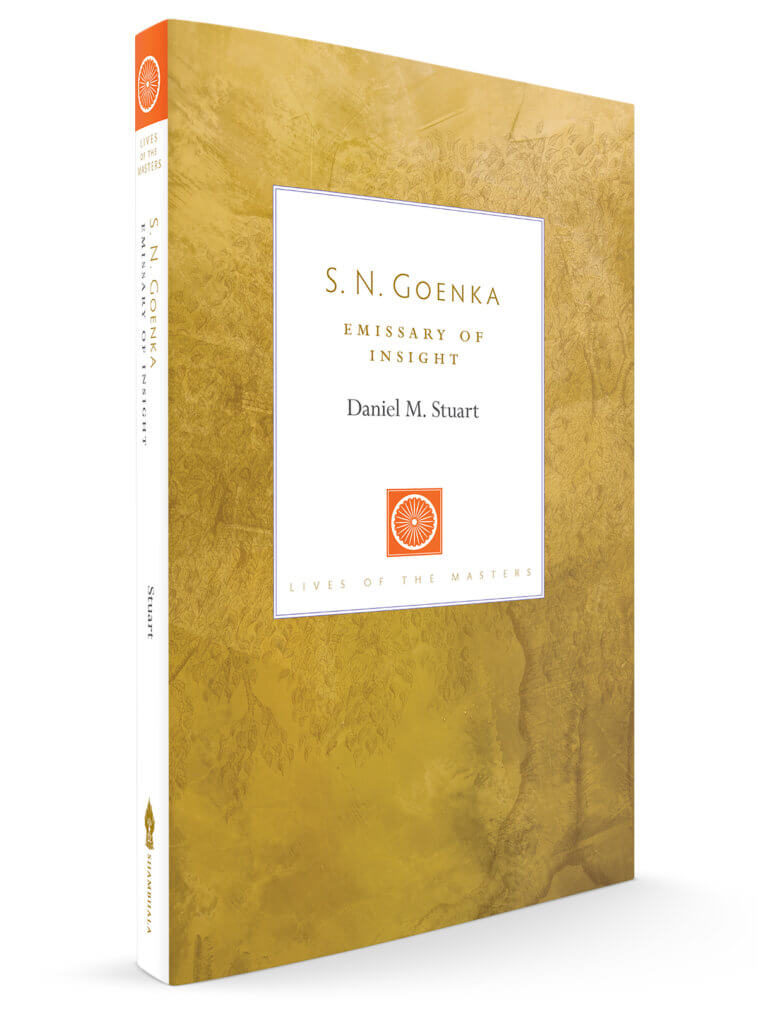
S. N. Goenka

$26.95 - Paperback

Drawing heavily on Goenka’s own autobiographical writings and Dharma talks, Daniel Stuart draws the first comprehensive portrait of the master’s life and demonstrates that Goenka’s influences, teaching, and legacy are much more complex than has been commonly thought. Stuart incorporates a wide range of primary documents and newly translated material in Hindi and Burmese to offer readers an in-depth exploration of Goenka’s teachings and his practice lineage in Burma. Stuart further details the trials and tribulations Goenka faced in building a movement in India in the 1970s, developing a global network of meditation centers, and negotiating a range of relationships with students and religious leaders worldwide. This fascinating addition to the Lives of the Masters series reflects on Goenka’s role in the revival of Buddhism in postcolonial India and his emergence as one of the most influential meditation masters of the twentieth century.

Munindra appears in this book given their close friendship.  Here is an excerpt:

Munindra’s participation was a defining moment for Goenka because his presence in Bodh Gaya brought to the surface questions about Goenka’s identity as the single true revivor in India of the Buddha’s pure teachings preserved in Burma. Munindra was a Bengali Buddhist who had spent nine years in Burma, from 1957 to 1966, studying ancient Pali Buddhist texts and learning meditation from a number of monastic teachers, most notably the Mahasi Sayadaw. Goenka was Munindra’s sponsor during that time, and the two knew each other well. But Goenka was not yet a teacher then. He had introduced Munindra to U Ba Khin, and Munindra had hoped to learn meditation from the latter. But U Ba Khin declined to teach him, since Munindra was already the student of a monastic teacher, and it was U Ba Khin’s policy not to teach those who were already students of other teachers. Apparently, U Ba Khin wanted to avoid the controversy that could arise from the comparison of practice lineages.

$21.95 - Paperback

Larry Rosenberg is one of the foundational vipassana teachers who brought the practice to North America and one of his teachers was Munindra.  This book contains down-to-earth wisdom on how to live a life of authenticity and spiritual integrity, from one of the West’s most respected teachers of vipassana meditation.

There is a section of the book with some very funny stories of Munindra.

Munindra’s participation was a defining moment for Goenka because his presence in Bodh Gaya brought to the surface questions about Goenka’s identity as the single true revivor in India of the Buddha’s pure teachings preserved in Burma. Munindra was a Bengali Buddhist who had spent nine years in Burma, from 1957 to 1966, studying ancient Pali Buddhist texts and learning meditation from a number of monastic teachers, most notably the Mahasi Sayadaw. Goenka was Munindra’s sponsor during that time, and the two knew each other well. But Goenka was not yet a teacher then. He had introduced Munindra to U Ba Khin, and Munindra had hoped to learn meditation from the latter. But U Ba Khin declined to teach him, since Munindra was already the student of a monastic teacher, and it was U Ba Khin’s policy not to teach those who were already students of other teachers. Apparently, U Ba Khin wanted to avoid the controversy that could arise from the comparison of practice lineages.

Joseph Goldstein's Experience of Insight

$19.95 - Paperback

In this classic of Insight meditation, Joseph Goldstein dedicates the book to Munindra.

And Ram Dass, in his introduction relates the following:

During my studies in India, one of the teachers who most perfectly embodied his teaching was Anagarika Munindra. The ephemeral nature of phenomena, including self, was no better demonstrated than in his absent presence. Originally a Krishnabhakta with Ananda Mayi Ma, he was drawn to Burma to pursue a Theravadin Buddhist sadhana. For many years Munindra so successfully absorbed the Pali Canon of Buddhism, an exact and complex no-nonsense blueprint of the mind, and the manner in which illusion is created and dispelled, that when I met him in Bodhgaya I found it difficult to differentiate him from the doctrine.

Despite the fact that Munindra-ji held a number of responsible administrative positions in the sacred city where Buddha had attained enlightenment, he commenced teaching. Among the students of this physically diminutive teacher was Joseph, a very tall young westerner who impressed me immediately by his power, simplicity, and quiet dignity. Like me, Joseph retained his western acculturation and yet was drinking deeply from the well of another culture’s insight into liberation, fully aware of the universality of the spirit.

$19.95 - Paperback

In one of Joseph Goldstein's most important books, he discusses Munindra in multiple places.

In my early years of practice in India, I studied with Munindra-ji, one of my teachers, in Bodh Gaya, the place where the Buddha awakened. Bodh Gaya is a small village with many beautiful temples, and as Munindra-ji and I would walk together through the village, he would often point out very simple village people who had been his students. Many of them had attained different stages of enlightenment.